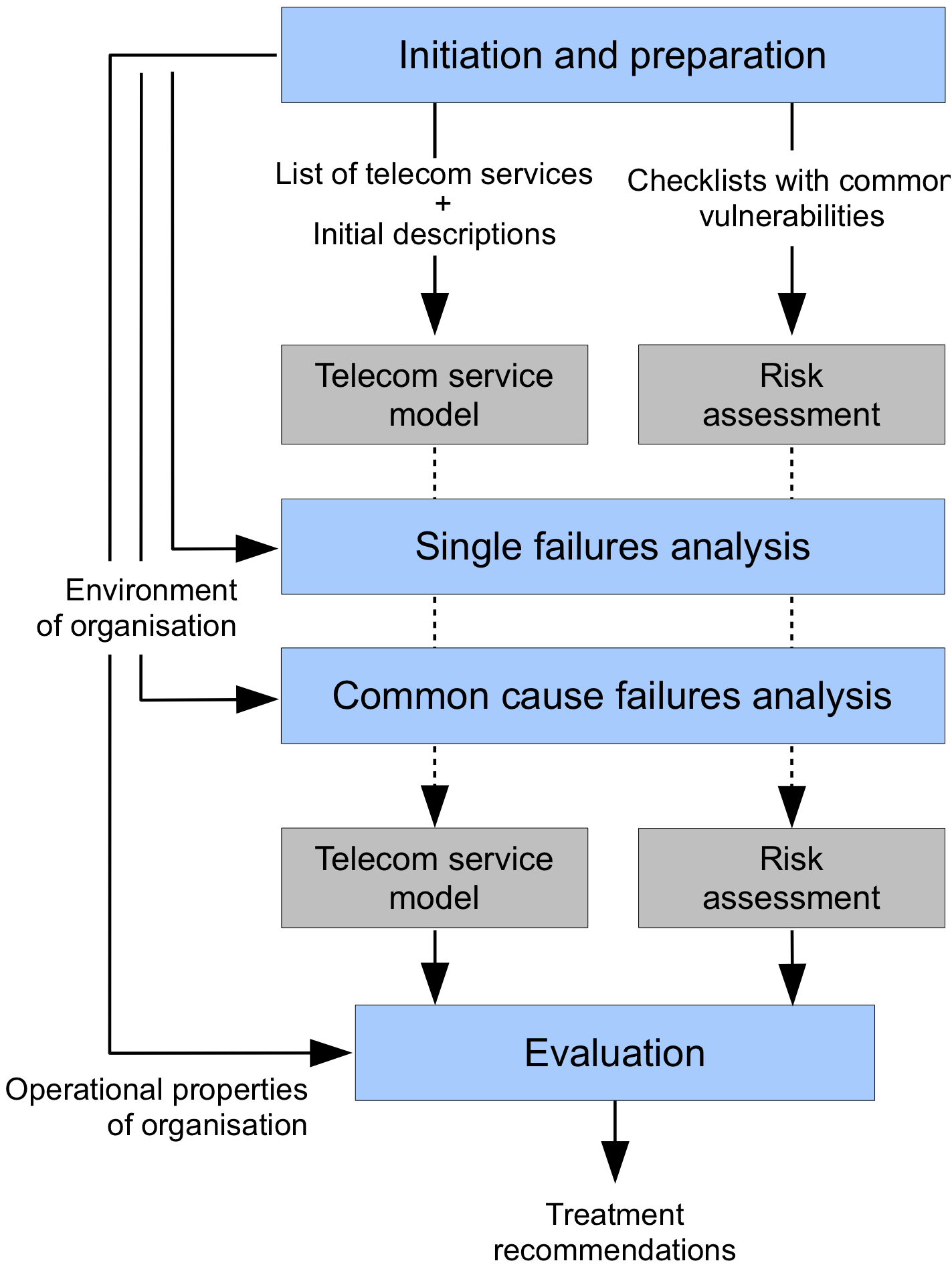
General outline of the Raster method and telecom service diagrams.
When using the Raster method, you and the rest of your team will perform a number of tasks. The method will guide you through these tasks in a methodical way, and the Raster tool will assist you in recording your progress. Based on your collective knowledge and expert judgement you will make estimates about the likelihood and impact of various vulnerabilities affecting the telecom services. Based on this analysis, you and your team will draft suitable risk treatment recommendations. The result of your efforts is a report that can be used by a decision maker to take informed business decisions about accepting, reducing, or avoiding the risks.
Raster consists of four stages, shown in the figure below.
The Initiation and Preparation stage describes the scope and purpose of the assessment. Which telecom services are involved, which users can be identified, who are external stakeholders, and what are the characteristics of the environment in which these services are used?
The Single Failures Analysis stage creates a telecom service diagram for each telecom service in use. These diagrams describe the most relevant telecommunication components, including cables, wireless links, and equipment items. These components are potentially vulnerable. The diagram does not have to be complete in all details. Parts of networks that are less relevant can be captured using a single “cloud” (unknown link). For all components an assessment of all applicable vulnerabilities is done. Only independent, single failures are taken into account during this stage.
The Common Cause Failures Analysis stage takes closer look at failure causes that lead to the failure of multiple components at once. One example is that of independent telecom services that both have a cable in the same underground duct. A single trenching incident may cut both cables at the same time, causing both services to fail. Another example is a large-scale power outage, causing equipment over a large area to fail simultaneously.
The Risk Evaluation stage contains the risk evaluation and creation of the final report. The overall risk level is assessed, and recommendations are done for risk treatment. These recommendations take into account the possible reactions of external stakeholders. The recommendations and their supporting argumentation form the final output of the Raster method. Stage 1, Stage 2, Stage 3 and Stage 4 describe each stage in detail.